Do Single-Artist CD Compilations Belong In Your Collection?
The Very Best Definitive Ultimate Essential Guide
Last updated March 2026
A CD collector will quickly realize that single-artist compilations are everywhere. Greatest hits, best of, essential, definitive, anthology, Icon, 20th Century Masters, and similar releases are abundant.
Over time I have come to generally avoid these releases, although collectors have different goals and may reasonably reach different conclusions. This article is not meant to dictate what or how to collect, but rather to point out some things worth considering before adding these discs to a collection. If I had thought through these points earlier, I probably would have avoided obtaining so many of these releases only to purge them later. My bottom line advice is to proceed with caution.
Single-artist greatest hits in the vinyl era
Greatest hits collections have long been part of the music landscape well before the CD era. In the vinyl era it was very typical for a label to issue a greatest hits album once an artist's output had slowed or stopped, although mid-career greatest hits were also common.
To entice fans, labels would often add one or two tracks that had not appeared previously on an LP to a greatest hits album. Examples include Bob Dylan Greatest Hits, which brought "Positively 4th Street" to LP and The Rolling Stones Through the Past, Darkly, which included "Honky Tonk Woman". Some vinyl compilations became so iconic that they are collected with equal enthusiasm as any studio release.
The compilation explosion in the CD era
With CDs, however, the issuing of compilations went into overdrive. Some artists have had multiple compilation releases. These releases have increasingly pretentious titles: the very best of, essential, definitive, collection, anthology, number ones, and so on. In addition, various series were created, including Icon, 20th Century masters, Classics. And of course many times there is no clue at all from the title that the album is a greatest hits compilation.
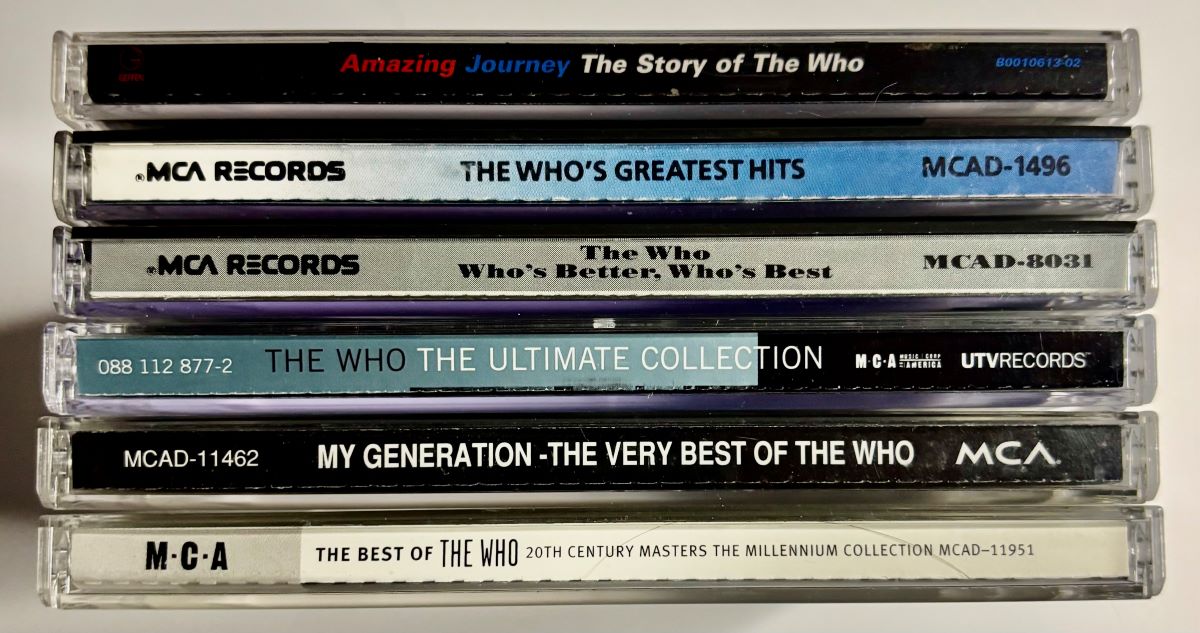
Not all compilation releases are the same. Some contain only tracks from studio albums. Others include previously unreleased songs alternate versions, or archival material. A single LP contains about 40 minutes of music, but a 2-CD collection if packed to the maximum will hold over three times as much, about 150 minutes of material.
The duplication issue
So what is the problem? First, many of these releases are highly duplicative. Greatest hits packages are almost certainly going to overlap heavily with one another. Also, over time a collector will likely acquire more original albums and the same tracks appear on those albums as well. One approach might be to reassess the inclusion of the greatest hits CD from time to time and cull it if it no longer serves a purpose.
No such thing as definitive
The decision on which tracks deserve inclusion in a collection is also subjective. Some of the major hits may be obvious choices, but for most artists once you get further into an artist's catalog there is plenty of room for debate. And the listener may have favorites that are omitted from the greatest hits package. For most artists there is no truly definitive greatest hits package.
Another issue is that a compilation is usually limited to songs owned by a particular label. If the artist moved between two or more labels then the CD will not be a complete view of the artist's career. The label may handle this by saying something like "the Columbia years". Or they may not even tell you that the collection is limited.
The original album as a statement
Many studio releases are album oriented. The entire album presents the artist's vision at the time, and often tells a larger story. A career compilation loses that context. On the other hand, some artists issued music more as a series of singles. This was especially true in the 1960s or earlier. In those cases a compilation may make more sense. Likewise some artists may have a limited output of "good" material and a greatest hits package may be an appropriate way of adding that artist to your collection without undue bloat.
When a compilation deserves a place
So to return to the original question: does a compilation belong in your collection? Personally I generally do not keep most standard CD era best of compilations. I prefer instead to acquire CDs of the original albums. That said, if there is an iconic vinyl era compilation I probably want that in CD form, for example something like Rolling Stones Hot Rocks or Beatles Red and Blue albums. But for the standard CD era best of, essential, type offerings, my answer is no thank you. In many cases the collector would be better served by finding original albums.
In some cases the new greatest hits release may use different mastering, either highly compressed loudness war style or an improved remaster optimized for CD. If those versions are not available on studio album releases, that might be a reason for a serious collector to add the CD even though the track titles are duplicative.
The greatest hits CD may include a different version or edit of the song, for example a radio edit, single version, mono mix, or stereo mix. This is also a reason a collector may add the CD.
Another feature that may appeal to the collector is if the release has substantially improved or expanded liner notes, and/or artwork.
Also, if a collector is a completist they may want all greatest hits releases regardless of overlap with other releases. But unless you are the Library of Congress, this behavior by necessity has to be limited to a few cherished artists.
Compilations with plenty of extra previously unreleased material are a different matter. In that case I would consider adding on an individual basis depending on how much new material there actually is. And there are plenty of releases that fall into this category. Would I prefer to have a CD of just the newly released material, probably yes. But it doesn't hurt much to have the duplicate tracks.
The beginner's mistake
An issue for the beginner is that they may have no sense of how common a given greatest hits CD is. They may pick it up thinking they may never see it again. With more experience, it becomes clear that these discs are often among the most common releases for many artists.
Final thoughts
Due to the grandiose titles, even a seasoned collector may pause when seeing one of these CDs for sale. That is why I recommend stepping back and looking carefully before buying. Single-artist compilations can have a place in a collection, but they should not be treated as automatic buys. In many cases they are duplicative, incomplete, and less impressive than their titles suggest. For me, they are a flashing yellow light.